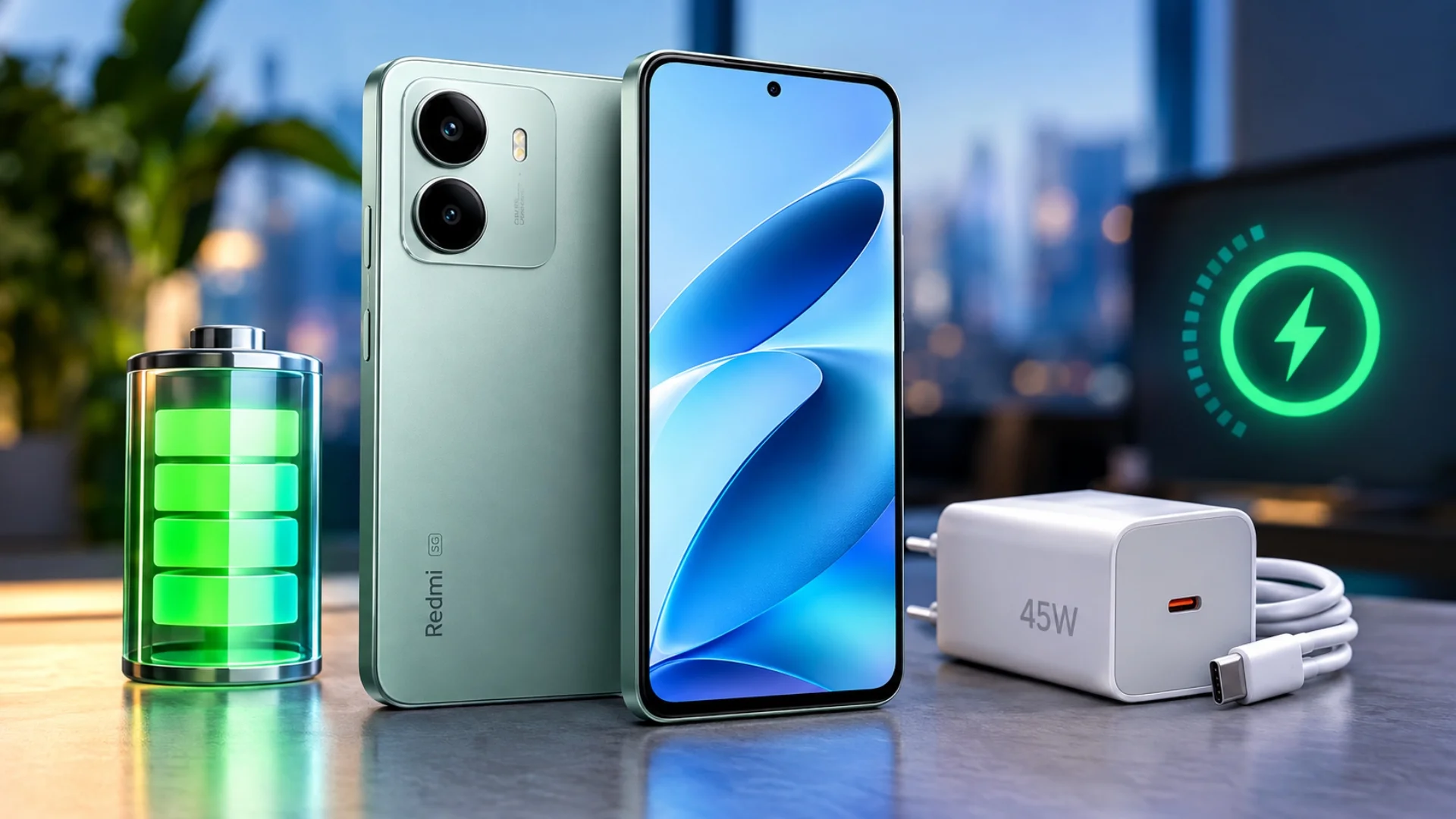
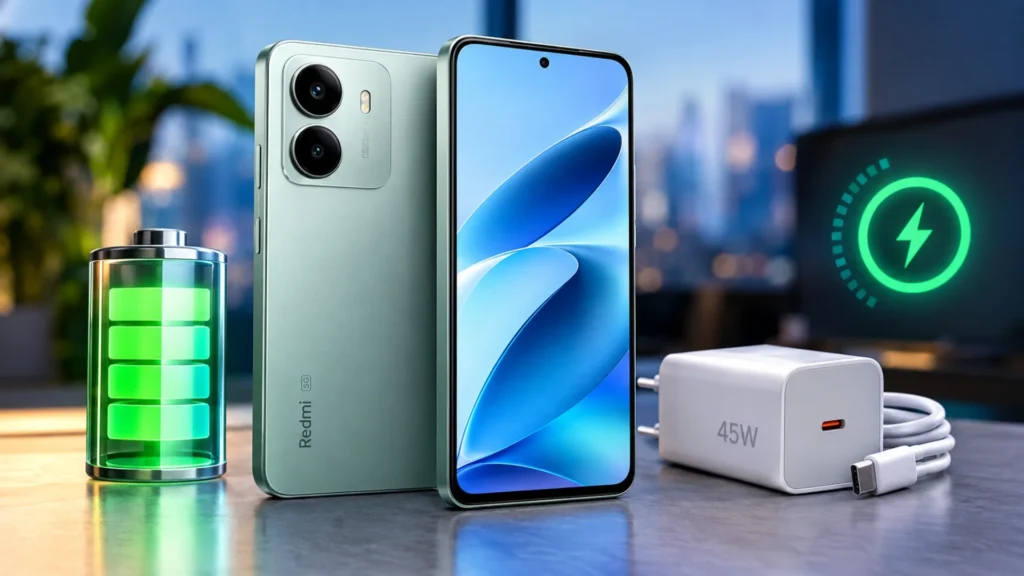
The Redmi Note 17 5G has now gone through battery and charging tests, revealing a major endurance improvement over its predecessor. Xiaomi has equipped the new model with a huge 7,700mAh silicon-carbon battery, while the 4nm Snapdragon 4 Gen 4 handles performance and 5G connectivity.
That combination appears to deliver a meaningful improvement in everyday endurance. Despite having a larger 6.99-inch 120Hz OLED display, the Redmi Note 17 5G managed to extract considerably more runtime from its battery than the previous-generation model.
Redmi Note 17 5G Battery and Charging Specifications
| Specification | Redmi Note 17 5G |
|---|---|
| Battery capacity | 7,700mAh |
| Battery type | Silicon-carbon (Si/C) |
| Wired charging | 45W |
| Reverse charging | 22.5W |
| Chipset | Qualcomm Snapdragon 4 Gen 4 |
| Chip fabrication | 4nm |
| Display | 6.99-inch OLED |
| Resolution | 1080p+ |
| Refresh rate | 120Hz |
| Network | 5G |
| Previous generation | Redmi Note 15 5G |
| Previous battery | 5,520mAh |
| Previous charging | 45W |
A Massive Battery Upgrade Over the Redmi Note 15 5G
The biggest hardware change is the battery. The Redmi Note 17 5G packs a 7,700mAh silicon-carbon cell, compared with the 5,520mAh battery inside the Redmi Note 15 5G.
That represents roughly a 39% increase in capacity. Interestingly, Xiaomi has retained the same 45W wired charging rating, while reverse charging is supported at up to 22.5W.
The larger battery gives the Redmi Note 17 5G considerably more energy to work with, although the larger display also puts additional demands on the phone.
Snapdragon 4 Gen 4 Brings a More Efficient Platform
The Redmi Note 17 5G uses Qualcomm’s 4nm Snapdragon 4 Gen 4 chipset. Its 4nm manufacturing process is newer than the 6nm process used for the Snapdragon 6s 4G Gen 2 in the 4G version.
The Snapdragon 4 Gen 4 also uses newer CPU cores. That combination gives the 5G model an advantage not only in performance but potentially in power efficiency.
The 4G and 5G versions otherwise remain extremely similar, with the chipset being the key hardware difference between them.
Redmi Note 17 5G Battery Life Results
The battery endurance results show a substantial improvement over the Redmi Note 15 5G.
According to the reported testing, the Redmi Note 17 5G improved its Active Use Score by almost five and a half hours compared with its predecessor. The increase is particularly notable considering the phone’s significantly larger display.
The improvement is broadly proportional to the battery increase. The battery capacity grew by around 39%, while the overall test score improved by approximately 38%.
That suggests Xiaomi has managed to preserve roughly the same level of efficiency while dramatically increasing the amount of battery available.
The 6.99-Inch OLED Display Makes the Result More Interesting
The Redmi Note 17 5G uses a 6.99-inch OLED panel with 1080p+ resolution and a 120Hz refresh rate.
That is larger than the 6.77-inch OLED display on the Redmi Note 15 5G. A larger panel can potentially consume more power, particularly when operating at a high refresh rate.
Despite this, the Redmi Note 17 5G still delivered a substantial endurance improvement. This points toward a combination of the larger battery and efficiency improvements from the newer 4nm platform.
Redmi Note 17 5G vs Redmi Note 15 5G
| Feature | Redmi Note 17 5G | |
|---|---|---|
| Battery | 7,700mAh | |
| Charging | 45W | |
| Display | 6.99-inch OLED | |
| Refresh rate | 120Hz | |
| Resolution | 1080p+ | |
| Chipset | Snapdragon 4 Gen 4 | |
| Battery increase | — |
The charging rating has not changed, but battery capacity has increased dramatically. That means the major upgrade is endurance rather than charging speed.
How the Redmi Note 17 5G Compares With the Realme 16T
The Realme 16T provides an interesting comparison because it carries an even larger 8,000mAh battery.
Despite having only a slightly larger battery than the Redmi Note 17 5G, the Realme model reportedly achieved around three hours more overall endurance in the testing. It also performed better in the call, web browsing and gaming tests.
However, the Redmi Note 17 5G came ahead in the video playback test.
The display technologies are also very different. The Realme 16T uses a 6.81-inch 144Hz IPS LCD panel with 720p+ resolution, while the Redmi Note 17 5G has a sharper 6.99-inch 120Hz OLED display.
Poco M8 Pro Takes a Different Approach
The Poco M8 Pro has a smaller 6,500mAh silicon-carbon battery, but it makes up for that with substantially faster 100W charging.
It also uses Qualcomm’s Snapdragon 7s Gen 4 chipset and features a 6.83-inch OLED display with a higher 1280p+ resolution.
This makes the Poco an interesting comparison because it prioritizes charging speed and a more powerful platform rather than simply maximizing battery capacity.
The Redmi Note 17 5G, meanwhile, takes a more straightforward approach: a very large battery combined with a relatively efficient mid-range chipset and 45W charging.
Redmi Note 17 Pro Falls Behind Despite a Bigger Battery
One of the more surprising results comes from Xiaomi’s own Redmi Note 17 Pro.
The Pro model has a battery that is 640mAh larger than the standard Redmi Note 17 5G, yet its endurance result was lower in the reported testing.
The Pro also has a smaller 6.83-inch display, although its 1280p+ resolution means it has more pixels to drive. It uses the 4nm Snapdragon 6s Gen 4 chipset.
On paper, the larger battery would suggest an advantage for the Pro, making its lower endurance particularly noteworthy.
Samsung Galaxy A37 Shows the Battery Gap
The Samsung Galaxy A37 was also included in the comparison. Its 5,000mAh battery puts it at a significant capacity disadvantage against newer mid-range phones using 6,500mAh, 7,700mAh or even 8,000mAh cells.
This does not automatically determine real-world battery life, since chipset efficiency, display technology, software optimization and usage patterns all matter.
Still, the capacity difference illustrates how quickly battery sizes are increasing in this segment.
45W Charging Remains the Main Limitation
The Redmi Note 17 5G’s 7,700mAh battery is impressive, but 45W charging is considerably less aggressive than the 100W solution found on the Poco M8 Pro.
A larger battery also means that charging from nearly empty to full can take a significant amount of time even with 45W charging.
For users who prioritize long endurance over rapid top-ups, this trade-off may be reasonable. Those who frequently need a quick charge during the day may prefer a phone with faster charging hardware.
What the Battery Tests Tell Us
The Redmi Note 17 5G represents a substantial step forward from the Redmi Note 15 5G in battery capacity and measured endurance.
The interesting part is that Xiaomi achieved this while moving to a larger 6.99-inch OLED screen. The reported results also suggest that the 4nm Snapdragon 4 Gen 4 is helping the phone maintain good efficiency.
The next comparison with the Redmi Note 17 4G should be particularly interesting because both phones use the same 7,700mAh battery and 45W charging system, leaving the chipset as the major variable.
For now, the Redmi Note 17 5G’s combination of a huge battery, 120Hz OLED display and 4nm Snapdragon platform makes its battery performance one of the more notable aspects of the new Redmi Note generation.










Top Mobile Brands












Latest News

iPhone 18 Pro Users Report Strange Popping Sounds From Earpiece After iOS 27.0.1

Tecno Pova Curve 2 Coming to Pakistan Soon With Dimensity 7100 and 8,000mAh Battery
Redmi Note 17 5G Endurance Results Are Here Xiaomi Made a Big Battery Leap

vivo X Fold6 Global Launch Could Be Close With Android 17 Confirmed

OPPO Find X10 Series Reveals 8,000mAh Battery and Triple 200MP Camera Power

Zawar Alam is a passionate technology and mobile phone content writer with years of experience covering the latest smartphones, gadgets, apps, and tech trends. He specializes in delivering accurate news, detailed specifications, feature comparisons, and helpful buying guides. His goal is to provide readers with clear, reliable, and up-to-date information to help them make informed technology decisions. Through his work, he stays committed to tracking the fast-changing world of mobile technology and consumer electronics.