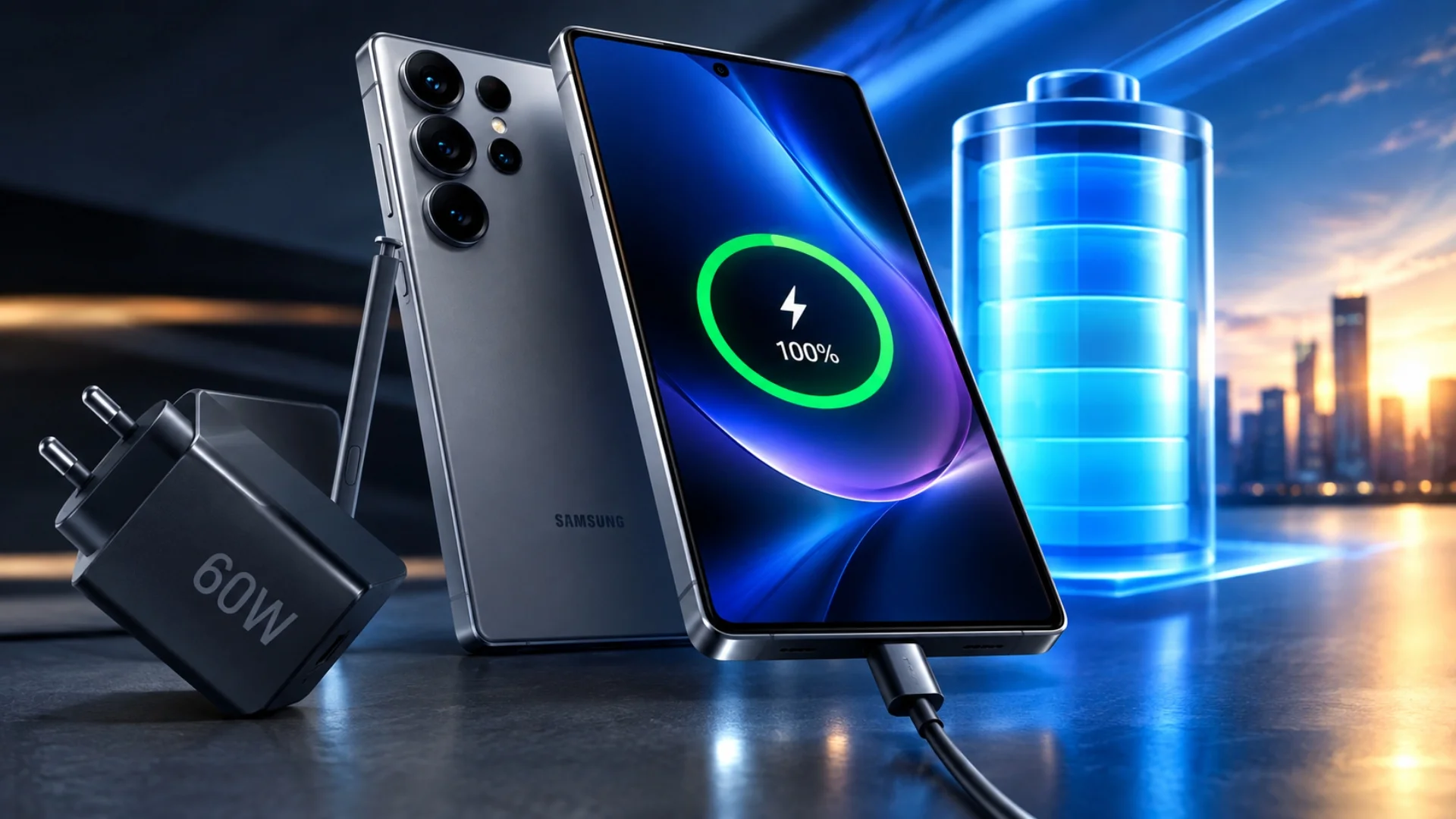
Samsung may have found a way to make the Galaxy S27 Ultra charge faster without pushing beyond the 60W charging limit introduced with the Galaxy S26 Ultra. The bigger 5700mAh battery sounds like it should take longer to refill, but early reports suggest the opposite could happen.
According to repeated leaks, Samsung is preparing a 5700mAh cell for its next Ultra flagship while keeping 60W wired charging. That combination has raised questions about how the company could improve charging times. Battery optimization or a move to silicon-carbon technology could provide the answer.
Galaxy S27 Ultra Could Keep 60W Charging
The Galaxy S26 Ultra marked an important change for Samsung’s flagship charging strategy, becoming the first model in the series to support 60W wired charging.
For the Galaxy S27 Ultra, Samsung reportedly isn’t planning another increase in the charging wattage. Instead, the company could be focusing on how efficiently the battery accepts and manages incoming power.
That would be an interesting approach. Increasing the charging limit is the obvious way to shorten charging times, but Samsung appears to be exploring improvements at the battery and power-management level instead.
5700mAh Battery Is the Biggest Change
The most important part of the current leak is the proposed 5700mAh battery.
Samsung has reportedly been testing or preparing a larger cell for the S27 Ultra, moving beyond the 5000mAh capacity that has been associated with recent Ultra models.
If the 5700mAh capacity makes it into the final phone, the S27 Ultra would gain roughly 14% more battery capacity than the current 5000mAh configuration.
| Specification | Galaxy S27 Ultra | Galaxy S26 Ultra |
|---|---|---|
| Battery Capacity | 5700mAh (rumored) | 5000mAh |
| Wired Charging | 60W (rumored) | 60W |
| Battery Technology | Silicon-carbon possible | Lithium-ion |
| Charging Optimization | Expected | Standard |
| Fast Charging | Yes | Yes |
| Battery Size Increase | Around 14% | — |
| S Pen | Yes | Yes |
| Status | Rumored | Official |
Galaxy S27 Ultra specifications remain unconfirmed and may change before Samsung’s official announcement.
How Could a Bigger Battery Charge Faster?
On paper, a 5700mAh battery charging at the same 60W should take longer to reach full capacity than a 5000mAh battery.
However, charging isn’t simply a matter of dividing battery capacity by wattage. The charging curve, thermal management, power conversion efficiency, battery chemistry and software controls all affect the actual time required.
A report circulating from an X leaker claims that the Galaxy S27 Ultra could complete a full charge around 2–3% faster than the Galaxy S26 Ultra despite retaining the 60W limit.
That isn’t a dramatic difference, but it would be notable because Samsung would achieve it without advertising a higher charging number.
Better Charging Optimization Could Be the Key
One explanation is improved charging optimization.
Samsung could potentially adjust the charging curve so the battery spends more time receiving higher levels of power during the most efficient part of the charging cycle.
Thermal management could also play a role. If the phone maintains lower temperatures while charging, the system may be able to sustain higher input power for longer instead of aggressively reducing charging speeds.
These improvements wouldn’t necessarily require a larger charging brick or a higher 60W rating.
Silicon-Carbon Battery Could Explain Everything
The more interesting possibility is Samsung adopting a silicon-carbon battery for the Galaxy S27 Ultra.
Silicon-carbon technology can offer higher energy density than conventional lithium-ion battery designs, allowing manufacturers to increase capacity without making the battery physically much larger.
That would make a 5700mAh battery considerably more believable in a flagship smartphone.
It could also help explain why Samsung might increase capacity while maintaining the same charging limit. A newer battery architecture could give the company additional flexibility in balancing capacity, thickness, thermal behavior and charging performance.
Still, the silicon-carbon theory remains unconfirmed. Samsung has not officially announced the battery technology for the Galaxy S27 Ultra.
Galaxy S27 Pro Could Follow the Same Strategy
The Ultra may not be the only Samsung flagship receiving this charging treatment.
The rumored Galaxy S27 Pro is also expected to feature 60W charging. If the reports are accurate, Samsung could apply similar charging and battery-management improvements to the smaller model.
The Pro could effectively follow the Ultra’s philosophy: don’t necessarily increase the headline charging number, but improve what the phone does with the available power.
Unlike the Ultra, however, the Pro is expected to omit the S Pen, giving Samsung more flexibility with its internal layout.
Could Older Galaxy Phones Get the Same Improvement?
This is one area where expectations should remain realistic.
If the improvement comes mainly from software and charging algorithms, Samsung could potentially bring some of the optimization to existing devices such as the Galaxy S26 Ultra or even selected Galaxy S25 models.
But if the advantage depends on new battery chemistry or revised battery hardware, older phones obviously couldn’t receive the full benefit.
Samsung could still optimize charging behavior through firmware updates, but there’s no indication yet that such an update is planned.
What This Means for Samsung’s Flagship Strategy
Samsung’s approach would be interesting because the company has historically been more conservative with charging speeds than several Chinese smartphone manufacturers.
Instead of chasing extremely high wattage figures, Samsung could be trying to improve real-world charging efficiency while keeping thermal and battery-health considerations under control.
The Galaxy S27 Ultra could therefore offer a larger battery without turning charging into a major compromise.
Bigger Battery, Same 60W, Faster Top-Ups
The reported combination is what makes this leak particularly interesting.
A 5700mAh battery would provide additional capacity, while 60W charging would preserve the same headline charging specification. If the reported 2–3% improvement is accurate, Samsung could still deliver slightly faster full-charge times.
That’s not a revolutionary charging upgrade, but it would demonstrate that charging performance depends on much more than the number printed on the specification sheet.
Galaxy S27 Ultra: What We Know So Far
At this stage, the 5700mAh battery and charging improvements should be treated as rumored specifications, not confirmed Galaxy S27 Ultra features.
Samsung is expected to reveal more information closer to the official Galaxy S27 series launch. Until then, battery capacity, silicon-carbon technology and charging performance could all change.





Top Mobile Brands












Latest News

Xiaomi 18 Pro and Pro Max Global Launch Confirmed With Smaller Batteries

Vivo V80 Pakistan Launch Details Leak With Bigger Battery, Faster Display and Premium Cameras

Dcode Cygnal Evo 2 Arrives in Pakistan With Galaxy Ultra-Inspired Design at Rs 33,999
Samsung Galaxy S27 Ultra’s 5700mAh Battery Could Hide a Charging Speed Upgrade
iPhone 18 Pro Owners Report Burgundy Discoloration Around the Camera Area

Zawar Alam is a passionate technology and mobile phone content writer with years of experience covering the latest smartphones, gadgets, apps, and tech trends. He specializes in delivering accurate news, detailed specifications, feature comparisons, and helpful buying guides. His goal is to provide readers with clear, reliable, and up-to-date information to help them make informed technology decisions. Through his work, he stays committed to tracking the fast-changing world of mobile technology and consumer electronics.