
Samsung is reportedly preparing a major battery upgrade for its next flagship, the Samsung Galaxy S27 Ultra. Fresh leaks indicate the company is advancing its work on silicon-carbon battery technology, which could finally address long-standing battery limitations in Galaxy devices.

For years, Samsung has relied on conventional lithium-based batteries. Meanwhile, several Chinese smartphone brands have already adopted silicon-carbon solutions, gaining an edge in battery capacity and efficiency.
Silicon-Carbon Batteries Could Change the Game
Silicon-carbon batteries offer higher energy density compared to traditional designs. As a result, manufacturers can increase battery capacity without making devices thicker or heavier.
Samsung’s current flagship, the Samsung Galaxy S26 Ultra, still uses a 5,000 mAh battery. This reflects minimal improvement over recent generations.
However, adopting silicon-carbon technology could allow Samsung to significantly boost battery size while maintaining a slim profile.
Internal Testing Reveals High-Capacity Prototypes
Leaked details, reportedly based on documents from Samsung SDI and shared by the Schrodingerintel blog, suggest the company is testing batteries ranging from 12,000 mAh to 20,000 mAh.
One prototype, identified as SDI-DC12K-SiC-V2, features a dual-cell design. It combines a 6,800 mAh cell with a 5,200 mAh cell, offering a compact yet high-capacity solution.
Reports indicate that a battery around 6,800 mAh could realistically fit inside the Galaxy S27 Ultra without increasing thickness significantly.
Durability Remains a Key Concern
Despite the promising capacity gains, battery lifespan remains a major hurdle.
The 20,000 mAh prototype reportedly achieved around 960 charge cycles before failure. This falls short of the industry benchmark of roughly 1,500 cycles for commercial devices.
This limitation may explain why Samsung has not yet introduced the technology in its current flagship lineup.
Focus Shifts to Improving Longevity
Sources claim Samsung engineers are now working on enhancing separator materials, refining battery stacking techniques, and improving battery management systems.
These efforts aim to extend battery lifespan and make silicon-carbon technology viable for mass-market smartphones.
A Potential Turning Point for Galaxy Flagships
Samsung has previously acknowledged that it trails some competitors in battery innovation. However, the latest developments suggest the company is actively working to close that gap.
If durability challenges are resolved in time, the Galaxy S27 Ultra could become the first Samsung flagship in years to deliver a significant leap in battery performance.










Top Mobile Brands












Latest News
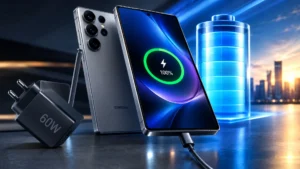
Samsung Galaxy S27 Ultra’s 5700mAh Battery Could Hide a Charging Speed Upgrade

iPhone 18 Pro Owners Report Burgundy Discoloration Around the Camera Area

iPhone 18 Pro Users Report Strange Popping Sounds From Earpiece After iOS 27.0.1

Tecno Pova Curve 2 Coming to Pakistan Soon With Dimensity 7100 and 8,000mAh Battery
Redmi Note 17 5G Endurance Results Are Here Xiaomi Made a Big Battery Leap
